
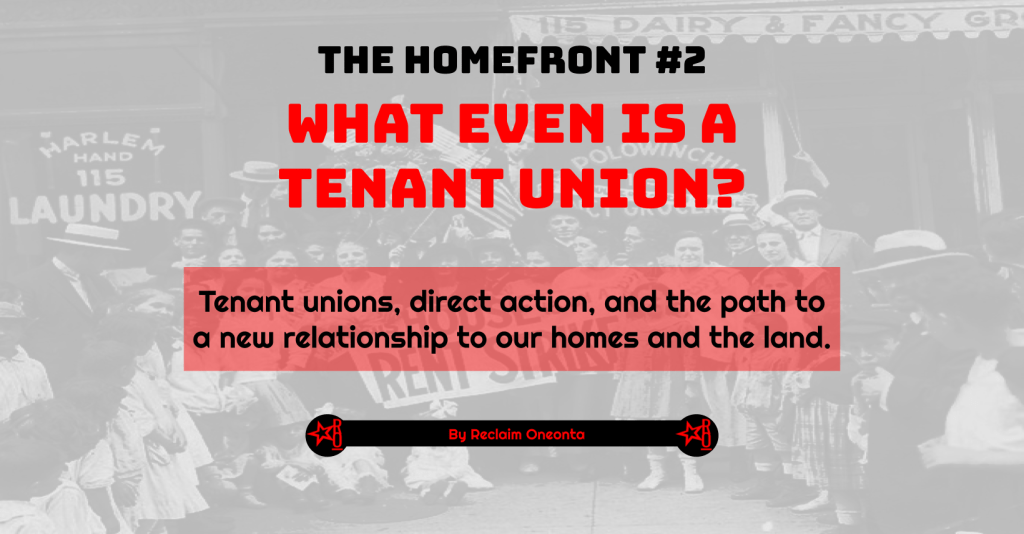
Hello, welcome to another episode of ‘The Homefront’ by Reclaim Oneonta, where we report on Oneonta’s class divide from the tenant’s point of view.
When we go out to talk to tenants in Oneonta about what we can do to solve our problems, one of the most common responses we get is, “what the hell is a tenant union?” This isn’t really surprising, since the corporate media has no real interest in talking about things that help working class people.
To cut a long story short, a tenants union is the name we give to a group of tenants in a city who have come together as an organization to act as one for their own, common interests. Strong or mature grassroots tenant unions typically exist at three levels. First, there are groups of tenants organized in a single building called tenant associations. Second, there are groups of tenants and tenant associations in a particular neighborhood, typically called a local. Then, bringing together all those units across a city will be the tenant union. Finally, tenant unions can join together and form a network or federation. This approach to forming tenant unions allows them to bring together tenants inside and outside of specific buildings.
What tenant unions do in their day to day affairs is basically up to them. Maybe they organize block parties, picnics, and game nights. Other tenant unions may hold info sessions on tenant’s rights. There have been some tenant associations that have organized neighborhood cleanups. Of course, most tenant unions and associations form with one basic objective: to empower tenants in our disputes with landlords.
It probably is easiest to understand this through an example. Imagine this year ends and your landlord raises the rent by 200 dollars. Instead of just accepting that and letting yourself get fleeced like usual, you decide that you want to negotiate for a lower rent increase. You have two ways to try. First, you could try to beg your landlord for a better lease. Fat chance that will work. So, instead, you take a different approach. You go around your building and find out if other tenants have had similar rent increases or other problems.
Once you identify a pattern of similar concerns, you decide to get together as one and make some demands of the landlord like lower rent increases year over year. Maybe this works the first time, and your landlord immediately concedes. More likely it doesn’t work on one try. This leaves you at a turning point. Either you and your neighbors give up, or you decide to increase the pressure. The second option would mean turning these meetings and actions more consistent. It would also mean becoming more intentional and confrontational in your actions. Maybe next time, you decide to picket outside of your building as a group to win public support. Or maybe you decide to fill up your landlord’s phone line. Maybe you begin a campaign to expose your landlord to the public. Maybe you have a potluck to get more neighbors involved in the campaign and build relationships. Maybe you decide to withhold rent. You could do all the above. By sustaining that sort of effort there is a much greater chance you win your demands.
Beyond those demands, you also built something over the course of those events. That something was an organization of tenants fighting for your own interests as a group. With the struggle over you could decide to dissolve and act like it never happened. Or, instead, you could decide that the culture of community, defiance, and direct action should continue. So, you decide to form a tenant’s association, always preparing for the next offensive from your landlord. Not all problems can be revolved in a single building. This same pattern of tenants unifying to pursue our common interests and solve problems can occur on the level of a city, between individual tenants and tenant associations. This creates the basis for a tenant’s union.
Tenant unions exist all over the world, and are becoming more popular in the USA, and operate in very diverse ways. When tenants come together to form a union, they can choose from different models. Traditional tenant unions are typically led by professional staff and lawyers. They emphasize lobbying and negotiating with landlords, similar to bureaucratic labor unions. This plays a role in their funding, with them oftentimes being backed by state agencies or non-profits and NGOs, relying on government funds. In turn, the decision making is typically handled by the paid staff and directors of the organization, rather than the tenant membership.
By contrast, the autonomous tenant union model, favored by Reclaim Oneonta, is strictly led by the tenant membership. Instead of a board or staff centric approach, autonomous tenant unions are governed democratically by the tenants themselves, and run on a volunteer basis. These unions rely on membership dues rather than government grants. In turn, they emphasize direct action by the tenants themselves rather than bureaucratic processes and lobbying. Reclaim Oneonta favors the autonomous tenant union approach because our goal is the direct empowerment of tenants over our own lives. We have to rely on our own strength to get what we want. A tenant union is not a service. It is a grouping of tenants that helps us organize ourselves for the fights with our landlords. This is the meaning of direct action.
Through direct action, tenants have been able to extract great concessions from their landlords in the past and present. Like in 1915, when over 20,000 tenants in Glasgow, Scotland went on rent strike to protest war time rent increases. Alongside the rent strike, they mobilized in large numbers to physically block attempts to evict tenant organizers and protested to get charges dropped for strikers. As a result, they forced the government to pass rent control and successfully got the charges dropped.
You could also look at the 1965 to 1968 rent strike in the labor camps of Tulare County, California. These rent strikes were organized by farm workers to fight against rent increases being proposed by the Tulare County Housing Authority, and ended with the tenants winning not only that but also improvements to their housing conditions.
Or for a more recent example, there is the 2017-2018 rent strike in the Boyle Heights, a neighborhood of 10,000 people in Los Angeles, California. This strike, organized by the LA tenants Union, was fought against a planned gentrification of the neighborhood through massive rent increases. As a result of the strike, tenants were able to block the gentrification plan and get localized rent control agreements directly from the landlord.
There are countless cases like this. In the future, we’ll go through each of these examples and more in greater detail. What they all have in common is that they represent instances of tenants winning what they want from landlords and local governments, not from lobbying politicians, but through direct action.
When organized tenants engage in direct action, we claw back some of the value taken from us through rent and some control over the places we live. But a tenant union can do more than just give us crumbs. Direct action also paves the way to a new kind of relationship to housing and land. A rent strike directly challenges the treatment of land and housing as commodities to be bought or sold, or as assets that exist to make a profit. The tenant union allows us to envision a reality where we manage the land for the common good and housing is guaranteed for all. Direct action in the tenant union is the bridge that connects the daily struggle for dignity in our homes and neighborhoods to the future of truly social housing and land. A future where the earth isn’t an object to be bought or sold, but a common treasury for all of us to share.
If you are also interested in building a tenant union to fight for yourself, come out to the Huntington Memorial Library on May 13th, from 6 to 7 pm. There, we’ll be taking the first steps to building a tenant union in Oneonta. For more updates on the tenant movement in Oneonta and beyond, subscribe, follow us on Instagram and facebook at reclaim oneonta, and check out our website. See you next time on the homefront.
 reclaimfed.org
Leave a comment