
False Understandings of socialism
The long red scare is over. Over the duration of the 20th century the ruling capitalist countries inundated the working class with anti-communist and anti-socialist ideas. There is no place where this was more true than the USA, where anti-communist propaganda was an essential tool in justifying a permanent state of war against the USSR and any force that rivaled American domination. This framework was turned internally against all kinds of enemies of the status quo, whether or not they were actually socialist. Everyone from civil rights activists to moderate labor organizers were cast as ‘socialists’ or ‘communists’ by their opponents in power. This was a tactic meant to attach those who disrupt the social peace to the hated national enemy, separating them from the masses. This nationalist propaganda was very effective during the post-war economic boom of the 50s, when workers could expect to ascend the social ladder under capitalism through their labor unions and a growing welfare state.
However, this economic boom was destined to end. Since the 1970s, the condition of American workers has entered an ongoing, zig zagging decline. The gutting of working class organizations and the welfare state was carried through greatly in the 1980s by Rondald Reagan, who acted as the representative of a capitalist class that could no longer afford to grant concessions to the workers it sought to exploit. As things are getting worse, old propaganda against socialism no longer works. The hated national enemy of the USSR is gone and the condition for drowning out the sound of class struggle with the trumpet of patriotism has left with it. For the first time in decades, socialist politicians are running against the rotten political establishment, promising change. It is no surprise that this message is appealing to working class young people, who are watching the American dream be ripped away from them in real time. For this layer, relatively unburdened by the anti-socialist sentiments of the 20th century, the word socialism represents hope instead of tyranny. There is a yearning for an alternative, and the democratic socialists of today, openly running on the label, seem to be offering that alternative to those unwilling to tolerate the ongoing crisis.
But what vision of socialism do they offer? The kind of socialism that politicians offer is based on using the government to make up for the shortcomings of capitalism. Taxes on the rich, rent freezes, and minimum wage legislation are meant to treat the symptoms of capitalism without removing the infection. It is an impossible war on effects and not causes. By leaving the power of the ruling class intact, these policy proposals advanced by the likes of Bernie Sanders and Zohran Mamdani are unable to really solve our problems. A close look at the political actions and proposals of these hated enemies of the establishment reveals their ultimate dependency on the kind permission of the ruling class and their political parties. For all of his luster against the democratic party elite, Bernie Sanders has consistently refused to act outside of its caged political program. Whenever the time has come, he has always fallen in line behind the genocidal leadership of the party, granting the working class nothing in return. Similarly, Zohran Mamdani, while combatting establishment candidate like Andrew Cuomo on a platform of the DSA, has openly stated that it is his intent to rebuild support for the party rather than break from it, wanting to govern as a “model for the democratic party – a party where we fight for working people with no apology”. He in turn has capitulated to the same rotten establishment of the party, protecting Hakeem Jeffries from a progressive challenger. Similar patterns of behavior can be found in all of today’s socialist political candidates. They offer a vision of socialism from above, delivered by traditional ruling class parties through welfare programs that leave the business class untouched.
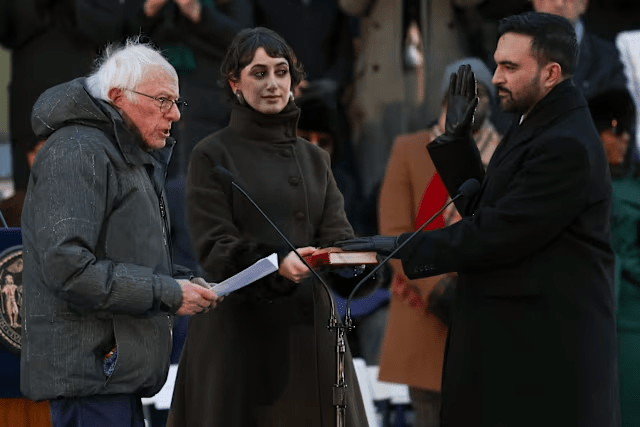
Zohran Mamdani swearing in at his Mayoral Inauguration
Even with these shortcomings, the appeal of these democratic socialists with young people remains high. Our blindness to the history of class struggle keeps us from seeing the dead end that is the bureaucratic vision of socialism we are being offered. While today’s young working class might be unburdened by the anti-communist mania of their parents, they are also unburdened by an understanding of the real conditions for the victory of the working class against the capitalists. There is a real need to move beyond the vision of bureaucratic socialism advanced by today’s socialist politicians. To do that, we have to turn to an older, more radical vision of socialism: the abolition of class society as a whole!
Toward the abolition of classes
Socialism did not always mean government control of the economy. Early socialists like the Russian Bakunin and the German Marx recognized that working class freedom would only come with a social revolution against the capitalist class and the government. This means dissolving state bureaucracies and the reclamation of the means of production (factories, fields, and workplaces) by the working class from the capitalist class. Instead of producing to enrich a few, our labor can be used to satisfy our own needs. This view, rooted in the hard truth of the class struggle, was in conflict with the views of the state socialists of the time. This difference was based on different views of the state. The state socialists saw the bureaucratic power of the government with its armies and legislators as a socially neutral force, acting in the interest of the whole country. With a few tweaks, they believed, the state could act for the working class. The social revolutionaries saw the ugly truth: the government, for all its talk about the liberty and equality of all citizens, is actually nothing more than the organization of the ruling class of capitalists as a whole.
There is nowhere this truth becomes more evident than the long history of the democratic state’s responses to the movements of the exploited class. In the Pullman strike of 1894, the national guard was mobilized to crush the strike, killing up to 40 striking workers (Urofsky, 2025). In 1916, a dozen IWW organizers were killed by the police in Everett, Washington. In 1937, the police, against a CIO organized strike in the steel industry, killed 18 workers and arrested thousands more (Riddle, 2011). Examples of the forces of the state being mobilized to crush strikes are remarkably common, and examples of the opposite have almost never occurred. Similar responses have occurred against all forms of activity that challenge the ruling class. Whether legislators are selected by vote or appointed by a dictator doesn’t really change this dynamic. Once in office, elected officials are no longer bound to the people who put them there. Even in the most democratic states, the majority of bureaucratic agencies and officials are unelected. Finally, the people who control the resources the government depends on to make its decisions are the capitalist class, who own the things that keep society running. A municipal official has no power relative to a major corporation that employs half the town, and can choose to invest or disinvest with relative ease. We actually celebrate the ability of politicians to make deals with capitalists for projects. The actual decision making in our society occurs behind closed doors between state and corporate bureaucrats, far away from the influence of the working class majority. I suppose we are expected to take it on faith that when economic elites meet with political officials they are prioritizing the interests of the working class just as much as their own.
What this reflects is that the class system is one that divides the world into a small caste of economic and political elites who rule on one pole, and a great mass of working people on the other who are ruled. As long as social classes exist, as long as capitalism exists, this basic relationship between lords and subjects will remain. There is no policy fix to this foundational problem. Anti-lobbying legislation and attempts to repeal supreme court decisions like citizens united, while understandably appealing, ultimately leave this relationship intact. Working people would still be subjects, left out of the actual decision making process, and forced to sell their labor power to the capitalist class and pay rent to landlords. On the other hand, the capitalist class, wielding their control over the basic needs of society as their weapon, would still exercise their power over the state. Socialist politicians, no less than liberal or conservative ones, still have to come to the table and make backroom deals with the commanders of the economy. Even if these industries come under control of the state, then it becomes state bureaucrats who exercise that power over workers who remain as powerless as ever. This is why we ultimately need a social revolution, and not just piecemeal social reforms.
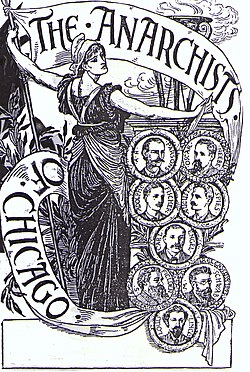
Art depicting the martyred Haymarket anarchists
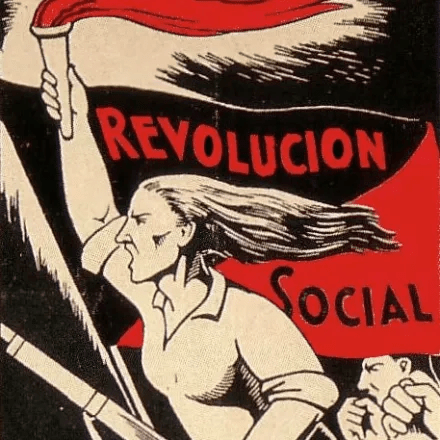
A social revolution is completely different from political revolution or social reform. A political revolution is about changing the form of government, with no regard for economic relationships outside the state. Social reform is about using the pre-existing state to modify economic relationships moderately. In a social revolution, political transformation is paired with the decisive factor of economic transformation, the overhauling of social relationships. To the socialists, this social revolution is the abolition of classes. Just as the victory of chattel slaves is the abolition of chattel slavery, the victory of the working class is the abolition of wage slavery. This can only be achieved when the working class decides to carry out a dual project of social and political transformation. Socially, this means the taking over of the economy by the working class through its own independent organization. This requires the expropriation of land, workplaces, factories, transportation networks, etc by the working class themselves, putting them under the democratic administration of the class as a whole, and not the state or any political party. In tandem with this project of economic reorganization, the working class must rid itself of the old government by force, replacing it with a system of direct worker’s power immune to the inherent corruptive nature of bureaucratic regimes. Historically, this task of dual economic and political transformation has been carried out through face to face assemblies of working people in their workplaces and neighborhoods, interlinked to one another by worker councils made up of delegates selected in and accountable to the assemblies. These kinds of organs gather the will of the entire working class and carry out social revolutionary decisions. By this assertion of popular will, the working class will destroy the system which divides people into rulers and subjects, replacing it with the free association of producers. This is what it means to abolish a class: to abolish the social structure which divides people into those who own and rule vs those who do not own and are ruled. This is what it means to go to the root. Without this social revolution, all the reforms of socialist politicians will be destroyed by the capitalist class. This liberation of the working class can only come from one group: the workers themselves!
Fighting for yourself!
The abolition of the working class will come from the direct action and self organization of the working class themselves. The only way to create lasting change is on the terrain of class struggle. You must take the initiative. History is filled to the brim with examples of working class people organizing themselves to fight capitalist exploitation in their workplaces and neighborhoods. From rent strikes to factory occupations, the working class has always been able to count on its own strength more than politicians in the class struggle. Our ability to get what we want in the short and long term rests, above all, on our own willingness to fight for ourselves. This is the strategy of direct action, class autonomy, and struggle.
There are many who will reject this notion. They will point out, correctly, that social change requires power rather than ideals, and so we must act to move where power already is. As a result of this perspective, they will advocate some combination of appealing to the rationality and human sense of the rich, making appeals to politicians, or running for office themselves as the real way to make basic change. After all, this is where power exists and can be mobilized for social good rather than evil. These people make two fundamental errors. The first is not understanding that the root of power is not primarily in the halls of government, whether it’s congress of the mayor’s office, or in the hands of individual corporate leaders, but in the economic relationships which underpin those positions. As was mentioned before, the capitalist system by its nature concentrates control of the material things which maintain society in the hands of a small class of people, which allows them to exercise decisive control over it. Since the real power is within this class system as a whole, no amount of wise political maneuvers from progressive politicians can really alter its direction from within. All of the well intentioned and heartfelt appeals to power made by the anti-Zionist protestors over the last two years did not sway the direction of the genocidal machine that is the US-Israeli alliance. The system already acts as it should, in the interests that it is beholden to, and it cannot act fundamentally in any other way.
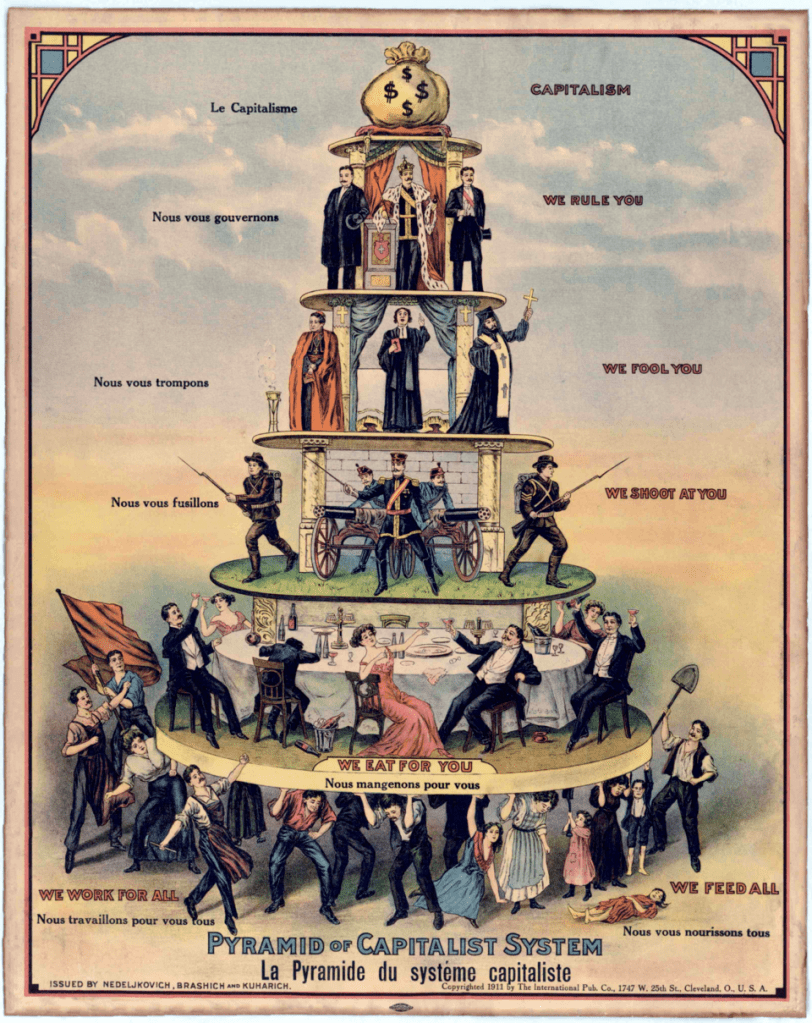
Art depicting the hierarchy of capitalist society
So then why does it sometimes appear like the state acts in the interest of the masses instead of capital? This can be explained by the second fundamental error, which is an extension of the first. Fundamentally, those who reject this notion reject the idea that working people can wield power themselves. The only way the masses can wield power, in their mind, is by voting once in a while for representatives in the state. When you understand that power flows up from material relationships that underlie production, you can see the error in this thought process. The working class, as the people whose labor creates the vast wealth of society, have latent social power. The firearms wielded by the police and army, the vast transport networks that transport society’s basic needs, the daily maintenance of society’s store of wealth in consumer goods, the wealth extracted by landlords, and so much more are all the product of the labor of the working class. It is this power that has allowed ordinary workers to upend entire regimes simply by denying them their labor, like when Russian Workers and soldiers in 1917 forced the Tsar to give up his throne through a mass strike. From the New York city rent strikes of 1931-1933 to the Stonemason’s strike of 1856, It is this social power, and the threat of it, that has forced the ruling class to give up concessions for its own survival. If we want change, it is to this power that we must turn.
The key is that this class power can only be realized when working class people organize with one another as a class in the places where we have the most strength. We must organize ourselves to confront the exploiting classes and impose our will on them. When will the workers arise? There is nothing the ruling class of our society fears more than the prospect that you, your coworkers, and your neighbors will fight for yourselves. This is the fight for socialism, the final chapter in the long story of class war!
Socialism or Barbarism
The anti-slavery fight of the 19th century was about overcoming a particular form of forced labor. By the whip and the force of government, black people were compelled to work for the benefit of a parasitic class of plantation owners. In the struggle against this system of slavery there emerged two tendencies. One tendency was basically reformist. Rather than confront this reality head on, they sought to place legal limits on its expansion. The other tendency, the abolitionists, saw that the class system of slavery had to be eliminated directly through forcefully taking away the special form of property that was at this system’s foundation, namely, the slaves themselves.
We find ourselves in a similar situation today. Capitalism is a system of forced labor where hunger and deprivation have taken the place of the whip in disciplining a class of servile people called the working class. This class of wage slaves are not owned themselves, but since they do not own the implements necessary to produce what they depend on, they still are compelled to labor for the benefit of a parasitic class of capitalists. In the struggle against the system of wage slavery there are two tendencies yet again. One tendency is reformist, the social democrats, seeking to limit the worst effects of capitalism without directly confronting the ruling class that creates this system. On the other end are the social revolutionaries. We see that the system of wage slavery called capitalism must be abolished through depriving the capitalist class of their special form of property. In the fight against chattel slavery, this called for an alliance between the enslaved and the other classes against the plantation owners to abolish the ownership of people, turning themselves over into the ranks of ‘free’ labor. In the fight against capitalism, only the working class itself can triumph by taking independent action to dismantle the old government and seize the means of production. Rather than producing for some parasitic class, the workers could carry on in producing to meet their own needs, with no masters above and no servants below. This is the final aim of the socialist movement.
Everywhere around the world, capitalism is writing its signature in the blood of the working class. In Sudan, Gaza, Syria, and Ukraine genocidal violence is being unleashed on masses of people. Donald Trump is currently threatening to plunge the USA into another imperialist war in Venezuela. In all of these cases, the capitalist system is responsible. While the rich wage the wars, it is the poor who fight and die in them. This is the true nature of the capitalist system: a barbaric war of all against all for the enrichment of the few. There is only one way to stop this: a social revolution which closes the book on class society forever.
“The working class holds the future in its hands. We pariahs have nothing to lose and, on the contrary, we can win our emancipation which is the destiny of the family of workers.” – The Friends of Durruti
References
The Friends of Durruti. (1978). Towards a fresh revolution.
Riddle, M. (2011, December 18). Everett massacre (1916). The Free Online Encyclopedia of Washington State History – HistoryLink.org. https://www.historylink.org/file/9981
Urofsky, M. I. (2025, September 12). Pullman strike. Encyclopedia Britannica. https://www.britannica.com/event/Pullman-Strike
“We Fight for Working People with No Apology”: Zohran Mamdani Beats Cuomo in NYC Mayoral Primary. (2025, June 25). Democracy Now!. Retrieved January 20, 2026, from
 reclaimfed.org
Leave a comment